Fore
Drag back, let go. Mind the wind.
Leaderboard
Loading…
More games
All games →
Tilt
Run · 3 stages
Flapjack
Run · 3 stages
Twist
Run · 3 stages
Seesaw
Daily · timed
Burst
Levels · endless
Eyeball
Daily · five figures
Putt
Quick · 3 holes
Holdout
Quick · 8 waves
Mix
Daily · five colours
Odd Coin
Daily · par
Fold
Daily · par
Ferry
Daily · par
Tempo
Daily · five beats
Corridor
Daily · 8 waves
Sky Skate
Run · 45 s
Chop Hop
Run · 3 boards
Rally
Quick · to 5
Count Rush
45 seconds
Word Six
Daily · unlimited
Sudoku
Daily · unlimited
Mini Crossword
Daily · archive
Minesweeper
Quick play
Color Flood
Daily · challenge
Block Fit
Endless
Number Rush
60 seconds
2048
Quick play
Memory
Quick play
Snake
Quick play
Chess
vs computer
Hex Settlers
vs bots
Four in a Row
vs computer
Tic-Tac-Toe
vs computer
Isolate
vs computer📖 Strategy guide: How to beat the robot at Fore: the wind table, the drop rule and the 20 m putt
How to play
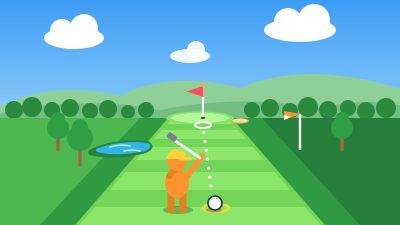
You stand behind the ball and look down the hole: a striped fairway between grassy banks, a flag with the distance beside it, a windsock by the tee. Press anywhere on the picture, drag back and let go. The ball goes the opposite way, like a slingshot: dragging straight down aims at the flag, down-left sends it right, and a longer pull is a harder hit, full power at about a thumb's length. Yellow dots on the grass show the line, white dots where the ball would fly in still air and a white ring where it would first land; the strip over the picture says where it would stop in still air, roll included, and how that compares with the flag (short, on the pin or long), over a bar that fills at full power. A very short pull is cancelled, and so is a flick up the screen towards the flag: drag back, never forward. A ball within a metre of the cup is the exception: a tap there taps it in, the slowest putt that drops, and it counts as a stroke. On a keyboard ← and → turn the aim 2° (10° with Shift), ↑ and ↓ change the power, Space or Enter swings and F held fast-forwards the flight.
The club is picked for you from where the ball lies: the driver when the flag is more than 30 m away, the wedge from 8 to 30 m (and from rough or sand inside that), the putter on the green or from the fairway inside 8 m. A full driver carries about 59 m and runs out to 70 m; a full wedge carries 20 m and stops near 24; a full putt rolls 20 m on the green. The ball rolls with the slopes, and the green tilts up to 1.5°, enough to move a 6 m putt most of a metre.
Wind, water, sand and trees
The wind is a whole number of metres per second, shown with an arrow in the strip, and it pushes the ball while it flies: a 6 m/s crosswind moves a full drive about 7 m and a wedge about 2.5 m. The dotted arc ignores it on purpose, so you read the wind yourself; on the first hole of a Quick round a yellow ring shows where the wind would really put that shot, once. A ball that lands in a pond or leaves the course (it is 68 m wide, and touching the banks either side is out) costs one stroke and is dropped two metres back from the last dry point of its flight towards where you played from (a little further if it needs a metre of dry ground round it), so a wet shot still gains ground. Rough caps your power at 80 %, sand at 60 %. Trees catch a ball that flies into their canopy and drop it straight down. The cup takes a ball that arrives slower than about 1.8 m/s; a faster one lips out and rolls on. After eight strokes the ball is picked up and the hole is scored as 8.
Scoring and stars
Your score is your strokes over the three holes, and lower is better. The robot's strokes on the same holes are the par: three stars at par or better, two within two strokes of it, one for any finished round. Beat the robot and the card says so. The scorecard at the end compares every hole.
Daily, par and challenges
A Quick 3 round draws three holes from a random seed: a straight 85 to 105 m hole with one bunker by the green and, on two seeds in three, a pond beside the fairway within a drive's reach; a 110 to 135 m dogleg; and a 155 to 185 m dogleg in a 2 to 6 m/s wind with two or three bunkers. The doglegs have a pond on three seeds in four, about four in ten of them across the fairway. The Daily is three fixed holes from the date, the same for everyone until midnight UTC. Before any hole is kept, a robot plays it with the game's own code, from the tee: it tries the driver at 13 aims and 6 powers, the wedge at 9 aims and 8 powers, the putter at 17 aims and 8 powers, plays on from the five best places each stroke leaves the ball, and the fewest strokes it needs is the par. A hole it aces or holes in two is thrown away, as is one it cannot finish in the window for its place in the round, so the par is 3, 3 (4 on about one seed in nine) and 4. ⚔️ copies a link to the course you are on so a friend plays exactly the same three holes.
Tips
- Read the strip before you pull. Wind 4 across means about five metres on a drive: aim that far into it.
- Put the white ring short of a pond, never on its far bank. A drop costs a stroke; a lay-up costs nothing.
- From rough or sand the full pull is not full power. Take the shorter shot you can actually hit.
- On the green, watch the dotted roll: it bends with the slope, and the slope is the one thing the picture hides.
- Hold a finger down while the ball flies to fast-forward. A round should take a minute.
How this one is made
The ball, the wind, the slopes, the trees and the cup are one small deterministic simulation that runs sixty steps a second, and the same code serves the preview, the robot and your shot. The picture plays it a little faster than life, a flight at 1.25 times its real speed, a roll at two to three times and the last three metres to the cup at one and a half, so a round takes about a minute; a finger held down runs it faster still, and neither changes where the ball stops. The robot that sets the par reads nothing: it tries its grid of shots and keeps what works, so a player who reads the wind and the slope can beat it. Over 200 random courses it needs 10 strokes on 89 % and 11 on the rest; a player who aims straight at the flag every time with the power the distance suggests, ignoring wind, slope and hazards, averages 3.5, 4.2 and 5.3 on the three holes, 13.1 against the robot's 10.1, and a player who only taps is picked up at eight on every hole. That gap is what reading the course is worth. The daily is drawn from the date and kept only if the robot finishes it in 11 or fewer, which it has on all 120 days from 1 November 2026 to 28 February 2027 without a second try.